E-Health Clinics in India
This is a health clinic in rural India using an interesting combination of clean water and e-healthcare. This business is being incubated by Ashoka, here is the original press release.
This is a health clinic in rural India using an interesting combination of clean water and e-healthcare. This business is being incubated by Ashoka, here is the original press release.

This is another story from VisionSpring. I realize I just made a reference to them in my last post but they are simply the most active participant online in this space and they provide a level of transparency that I cannot access from other initiatives. I hope to continue to provide variety in the examples but in the end we're looking for principles--
VisionSpring has been piloting with BRAC in Bangeldesh and are now about to "spring" into a full implementation of their program but they are struggling with meeting the inventory demands of BRAC, particularly in terms of getting product into the country from their factory in China.
This is a very common problem, I was just on a call with an organization that ships high-nourishment food packets across borders and getting through customs is one of their biggest challenges. I see the Grameen-Danone model of mini-plants as an innovation that will help to overcome these challenges in the short term and I think the model should be attempted by more but not all products can be streamlined into mini-manufacturing. The challenge of low prices and high volume for the bottom of the pyramid may ultimately be best served by large plants with great distribution systems.
Are mini-plants the engineering innovation needed for bottom of the pyramid products?
There was a great highlighted technology over on Afrigadget that could lend itself to a branded microfranchise. It would be a briquette making business. There are other technology designs out there but the idea of a briquette making business is very appealing because it can address multiple issues in one intervention, i.e. as a business it would obviously seek to create jobs and increase incomes but selling briquettes would also bring some great positive benefits to the health of the family and the local environment.
The D-Lab out of MIT reminds us that charcoal is a smokeless fuel, cutting back on the indoor air pollution that leads to so many respiratory infections in children where there is open fire cooking in the home. In terms of the environment, charcoal can be made from agricultural waste which would otherwise be burned off as waste. This is particularly critical in a country like Haiti where deforestation is at a dire level. For a quick introduction to the technology GOOD Magazine did a great little article on this and other basic technologies a while back.
Has anyone has success or failure in attempting to launch a briquette making franchise. What were your greatest challenges?
The post below was authored by Julia Tran and ran a couple weeks ago on NextBillion. It is about a franchise called CareShops in Ghana that converts existing small businesses into franchised shops. I did my graduate work in Ghana and had some interaction with one of the individuals who launched CareShops (who has since been recruited by Freedom from Hunger to launch their HealthKeepers social enterprise). The extent of the network of "chemical sellers" in Ghana was really quite remarkable; in nearly every village I visited I was able to find a chemical seller. The problem of course is that their medications were of questionable quality and their inventory varied considerably. CareShops is a brilliant effort to do nothing more than strengthen this existing network with branding, standardization of medications, and increased training. In theory the government already provided these services to the chemical sellers but in reality the government has far too few resources to be able to follow through on all their regulations to demand compliance. On the other hand, CareShops, as a for-profit business, has an incredibly high motivation to demand compliance in order to maintain the integrity of their brand. The concept of conversion should cause any social entrepreneur thinking of building a franchise system to do their research to understand current networks of business in the informal market before building anything from scratch.
Though I'm no longer on WRI and NextBillion's staff, I'm glad to announce the release of WRI's latest What Works business case study, CareShop Ghana: Improving access to essential drugs through conversion franchising. This study is authored by Joel Segre (Harvard Business School, '08) and myself, and was made possible through the generous support of the Horace W. Goldsmith Foundation.
NextBillion has discussed pharmacy microfranchises in the health sector on numerous occasions, but CareShop is unique among them as a conversion franchise that recruits existing drug store owners, rather than a "green field" franchise model that establishes new outlets. A conversion franchising strategy has great potential especially in Ghana, where an extensive network of 8,000 individually run retail drug stores, known in Ghana as "licensed chemical sellers," already reaches every corner of the country.
CareShop's founders interpreted the prevalence of easily treatable infectious diseases in Ghana as significant unmet demand for better access to more affordable drugs, and endeavored to meet this demand by working with chemical sellers in a franchising arrangement. CareShop, as the frachisor, runs on a for-profit basis and generates revenue from product sales to chemical sellers as its franchisees. CareShop provides franchisees with valuable business and healthcare training, branded materials, and the convenience of having products delivered directly to their doorstep. CareShop is a program run by Ghana Social Marketing Foundation Enterprises Limited, which itself is a for-profit subsidiary of Ghana Social Marketing Foundation (GSMF), a non-profit organization.
To date, there are 276 CareShops operating in Ghana, the oldest of which joined the franchise in 2003. CareShop has been in operation longer than many drug store microfranchises, which afforded Joel and me the opportunity to work with a larger set of business records and observe clear trends in CareShop's outlook. In the case study, we endeavor to present a thorough analysis of both the inherent challenges of implementing a conversion franchising model and the benefits of such a model to franchisees and to some extent, the pharmaceutical retail market.
The case study may be of especial interest in light of the recent discussions on NextBillion regarding scaling strategies and on the value of fostering talent at the BOP. Franchisees eagerly embraced training opportunities at the time of their conversion. Indeed, GSMFEL's well received training program helped CareShop to scale rapidly during its first couple years of operation. Franchisees were selective, however, in which lessons they chose to apply. Changes in business practices that led to immediate payoff were more popular than changes that do not have readily apparent benefits. Yet some franchisees even resisted behavior changes that seem to offer advantages over old ways of doing business, such as using GSMFEL's delivery service rather than having to travel to wholesalers in the city.
The mixed success of GSMFEL's training program offers insight into the advantages and disadvantages of working with an existing group of entrepreneurs. Download the case study for more details on this topic and other lessons learned from GSMFEL's experience serving the base of the pyramid by engaging microentrepreneurs.

Friends of Living Goods,
Living Goods, known as the “Avon of Rural Health”, is delighted to share the following milestones from this last fast-paced year on our journey to becoming the first fully sustainable system for defeating the diseases of poverty:
• Last May Living Goods and BRAC signed a joint venture agreement to collaborate on building a Living Goods network serving 20+ districts in Uganda.
• The Rockefeller Foundation, Mulago Foundation, Causal Fund and the Horace W. Goldsmith Foundation each awarded core funding to Living Goods.
• Extensive research, field study and customer focus groups helped LG identify its first 28 health products which are now in stock across the LG network.
• In a sizable launch, Community Health Promoters were carefully selected, trained equipped and deployed to serve 200 communities.
• Poverty Action Lab began helping Living Goods design a best-of-class randomized evaluation system to measure LG’s key objectives of dramatically reducing mortality and fertility rates.
• Harvard Business School and the Harvard School of Public Health selected Living Goods to participate in their Project Antares field study.
• Living Goods was awarded an exclusive Draper Richards Fellowship.
• Most recently Living Goods began developing plans to market low cost solar lanterns and high efficiency cook stoves to help poor households dramatically reduce fuel expenses and indoor pollution.
• Chris Elias- President of PATH, Paul Polak - Founder of IDE, and Erastus Kibugu of Technoserve Uganda joined the Living Goods Advisory Board.
We extend our sincere thanks to all who helped LG reach this important juncture. In particular we want to acknowledge the BRAC Uganda team and their exceptional director Mr. Khondokar Ariful Islam. Their commitment, experience and professionalism are unmatched and indispensable.
Of course this is just the beginning. We will add 300-500 more Health Promoters before the end of the year, and scale to 3,000+ in four years serving four million people in Uganda alone. In the coming years LG plans to replicate this model across the developing world with other world class partners and test expanded product offerings in clean water, power and small holder agriculture. In fact a half dozen multinational NGOs are already expressing keen interest in collaborating with LG to implement its innovative system in other countries.
Naturally, along with these opportunities abundant challenges lie ahead. Living Goods represents a disruptive innovation in rural health care that will require considerable trial and error. Building a truly sustainable, replicable business model will be one measure of Living Goods success; the far greater success will be counted in the many diseases prevented, the many children saved, and the many healthy productive years families will enjoy by virtue of having affordable essential medicines within reach.
Please feel free to contact me directly (cslaughter@livinggoods.org) if you have any questions, or are interested in partnering with or supporting Living Goods.
To Your Health,
Chuck
I'll start with Freedom from Hunger and their MicroBusiness for Health Initiative. I, of course, am biased towards this project as I was involved in the needs assessment which turned out to be my main graduate work. Ellen Vor der Bruegge was the presenter.
Quick summary: Preventative health products in a basket sold by an microcredit borrower in rural Ghana patterned after the Avon or Tupperware models that were successful in rural America beginning in the late 1800's.
FFH could be considered the new kid on campus, they are just launching their program. They have put together a team of ladies to pilot the business and provide feedback. The name of the business is HealthKeepers and I like the fact that the women sellers chose the name for the business. As expected, they sell insecticide treated nets, condoms, and ORS packets with zinc but they also sell a handful of products, which Ellen called their “door-openers”. What would you guess is their biggest seller? Now, this is a region where malaria is hyperendemic, polio still exists in pockets, and children die everyday from ailments such as diarrhea. The answer, drum roll.... athlete's foot powder. That in and of itself is amazing--no traditional public health intervention would focus on athlete's foot, yet, market feedback identified a quick and simple product that is viewed to have high value in terms of quality of life. I think the key is that they experimented, they put something out there and let the market respond. If athlete's foot cream gets the customers attention which allows the HealthKeeper to explain the cost-benefits of investing in an insecticide treated net then I hope they become the largest distributor of athlete's foot powder in the world. I also liked that they gave free products to their entrepreneurs to try out, creating converts of the products, and subsequently creating a very convincing sales force. They also allow the seller to give away some products in the village to stimulate demand. I also liked that they try to source products locally.
Some of their challenges: Pricing--so that all parties in the value chain are sustainable. They are constantly trying to balance their three goals: increased health protection, providing a living wage for the entrepreneur, as well as create a sustainable business themselves as the franchisor. Another main challenge, and it was echoed by other presenters, is free handouts by other programs. There must be dialogue between the various NGOs and government entities working to fight malaria. I personally feel that it is better to sell the nets, that it will be perceived with greater value, that it is more likely to be used and maintained, that it will lead to consistent supply and greatest penetration.
They are aiming high looking to have 4-5,000 HealthKeepers covering all of Ghana. I'm excited to watch their business grow over the next couple years. As they say at FFH, Onward!
Concept Paper
Blog Discussion among HealthKeeper staff
Chat with field director
Today as I was driving I listened to an old podcast from GlobeShakers from the Stanford Center for Social Innovation, the guest speaker being Don Gould speaking about Pure Water for All.
In the interview Don describes a microfranchise model for manufacturing and distributing the ceramic water filters. It sounds like a great model: using locally available materials, creating jobs for local communities with a tremendous social return on investment. This interview was back in 2005, does anyone have an update on their project?
Scojo Vision Entrepreneurs has been selected as a finalist for the Disruptive Innovations in Health competition at Changemakers. I have highlighted Scojo on this blog as one of my favorites and know they are prominent examples in Micfranchise publications. Voting is open until August 29th.
The entry for Scojo also details their delivery model and financial model with a level of detail that is hard to find elsewhere.
I will also point two other microfranchise models that were not selected by the judges to be finalists. One is Freedom from Hunger's MicroBusinesses for Health for which I personally conducted early research. The other is Honey Care Africa which was one of my first posts.
This post is from NextBillion:
"I'm very happy to announce the release of the WRI business case study, What Works: Mi Farmacita Nacional, authored by Enrique Coronado ('08), Christina Krettecos ('07), and Yvonne Lu ('07) of Columbia Business School.
Mi Farmacita Nacional, a fully for-profit pharmacy franchise, is among the first retailers of generic medications to serve low-income communities in Mexico. Mi Farmacita was launched in 2003 and has since more than doubled its number of outlets every year to reach 57 outlets as of March 2007. Outlets in operation for a minimum of 22 months are now processing an average of 2,400 transactions/month in sales of affordable medications, doctor consultations, filtered water, telephone access, and other essential products and services.
What Works: Mi Farmacita Nacional analyzes the business strategies that have enabled Mi Farmacita's rapid growth and success in serving low-income communities.
This case study was made possible through the generous support of the Horace W. Goldsmith Foundation and Social Enterprise Program at Columbia Business School."
A couple thoughts as I read through the Case Study:
I find it interesting that the business is purely for-profit and is the joint effort of two large companies in an effort to tap a new market and not necessarily a social enterprise that started off with the goal of helping the poor. I would place it under the philosophy of the "Fortune at the Bottom of the Pyramid" folks. I think they have great potential to bring essential goods and services to the poor but I would also like to see a system of checks or audits to ensure that they will stay socially responsible as they deal with the poor.
I like their goal to be "accessible by foot" as they choose store locations.
I like the inclusion of phone and internet health services which they cite as significantly increasing store traffic.
I found it interesting that 70% of franchisee recruits reported the company website as their source of discovery of the business opportunity.
I looks like helping potential franchisees finance their startup costs is the major barrier to accelerated growth at the present time.
I'll be interested in following their progress in the near future.
Julie Tran over at the World Resources Institute published a post yesterday about product franchising and the delivery of vaccines.
I think the model is especially appropriate for product distribution in urban settings. From my experience in urban informal markets there seem to be so many people selling the same products. And doing so in nearly every major bus stop or market across the country. There must be distribution systems behind those products. It could simply be a matter of channeling appropriate technology products alongside those same products.
I also like two elements of Abhay's system: supplying doctors with refrigerators free of charge and providing the first 30 vaccines free of charge. Capital equipment and financial risk with a new product are strong barriers to new product adoption. Those are excellent incentives for individuals to become franchisees.
I have previously blogged about my involvement in a pharmacy-in-a-box project with Freedom from Hunger as well as Living Goods and their Avon-lady sales strategy. The Health Plus Pharmacies program in Philippines is perhaps the model furthest along in terms of implementation and coverage. I wasn't able to find a presence on the web, if anyone knows of one provide a link as a comment.
It launched in 2001 as a project of the Philippines Department of Health and the GTZ German Bank for Reconstruction. The project is called the National Pharmaceutical Foundation Inc. (NPF). The NPF provides 3 franchise shops: a health plus outlet (limited product line, no required pharmacist), a Shop-in-a-shop (counter space in a government pharmacy or coop), and a Health Plus Pharmacy (full product line, full-time pharmacist and part-time doctor required). The NPF provides the business model, handles product distribution, branding, store design, and conducts performance audits.
NGO's or individuals can purchase the franchise. Startup costs for an outlet are US$400. The average franchise fee is US$156 plus .5 percent annual fee of all drug purchases.
Franchisees are able to absorb 70% of the store's income. As of June 2005 there are 317 Rural outlets, four shop-in-a-shop stores, and three pharmacies.
I think the strength of this project is the balance between government oversight and private business. The Department of Health brings key funding and management resources while the franchises themselves function according to the market, and the efforts/quality created by the owners.
I also think the multi-prong shop types gives the venture added depth. The Health Plus outlets, although offering a limited product line, can benefit from the reputation of the full service pharmacies.
Source: Where there are No Jobs vol 4
Two new latrine designs that I can across: the Eloo and Cemforce.
The Eloo was designed in South Africa and has won numerous design awards. It was also reviewed in the Stanford Review of Innovative Products Benefiting Humans. I could see a manufacturing plant in the main city of a poor country and then microfranchises of installation services. The U.S. distributor is Cleanup America.
Cemforce offers a few different products. The one that caught my eye was their VIP (Ventilation Improved Pit) because it advertises as being able to build in less than 10 minutes, with no special cranes or tools. I'm always a sucker for simplicity.
This is another case where the microfranchisees would more likely be installers or distributors.
“Rat catching is an occupation for many poor people in the agriculture fields of India. The 25 percent crop loss due to the rat menace is economically devastating to farmers through the country. The income of rat catchers ranges from US $15 to US $30 a month. They use a traditional earthen pot fumigation method to kill rats in their burrows. This method comes at great cost to the fumigators' health as they inhale smoke that leads to severe occupational health problems, including problems with the respiratory system, heart and eyes. A study shows 30-40 percent of the rat catchers have one or many of these health complications.
The Center for Development of Disadvantaged People has developed a technology that would eliminate these health hazards and more than double a rat catchers' income because its method is twice as efficient. The cost of the instrument in between US $20 to US $25. Eliminating rats is essential to Indian agriculture, and the distribution and use of this technology could prove not only beneficial to farmers, but also to entrepreneurs in the rat catching business. “
I like this example for the simplicity of the technology, the low start-up costs, and the ease of training. How many places in the world could benefit from this technology, how many crops could it save?
Source: Where There Are No Jobs Vol. 4
There was a story about Scojo over at nextbillion the other day detailing Scojo's teaming up PSI, Population Services International. The five year agreement will couple two winners of FastCompany's Social Capitalist Awards. It is not clear from the article if the arrangement will keep the microfranchise model, the Scojo Vision Entrepreneurs, or if PSI will simply offer reading glasses as part of their product line. Either way it will bring vision care to rural Africa in an efficient and widespread manner.
This technology has been featured on AIDG, the Rolex Awards, and Treehugger.
"The pot-in-pot consists of two earthenware pots of different diameters, one placed inside the other. The space between the two pots is filled with wet sand that is kept constantly moist, thereby keeping both pots damp. Fruit, vegetables and other items such as soft drinks are put in the smaller inner pot, which is covered with a damp cloth. The phenomenon that occurs is based on a simple principle of physics: the water contained in the sand between the two pots evaporates towards the outer surface of the larger pot where the drier outside air is circulating. By virtue of the laws of thermodynamics, the evaporation process automatically causes a drop in temperature of several degrees, cooling the inner container, destroying harmful micro-organisms and preserving the perishable foods inside."
Brillant design. Simple. Affordable for the poor. Impact of Health and Malnutrition. Job Creation. As of 2005 the inventor had delivered over 90,000 pots. How many more places around the world can benefit from this product? How can we get it to them?
Formerly known as ITDG (Intermediate Technology Development Group), Practical Action has collected a wide range of technological solutions that are appropriate for people at the bottom of the pyramid. Some of the greatest resources on the site are the technical briefs that give details about projects ranging from an improved donkey plough to compost toilets to bicycle ambulances. The question becomes-how can we get these products and the technical information out to the people.

This food processing microenterprise is called VitaGoat and has been developed by the folks over at Malnutrition Matters: Food Technology Solutions. Their system was previously recognized as a Tech Museum Award Laureate in 2005. I like that the system is self-contained, but I do wonder if a more sustainable fuel can be incorportated into the system, perhaps the charcoal innovations from MIT that I highlighted in a previous post.
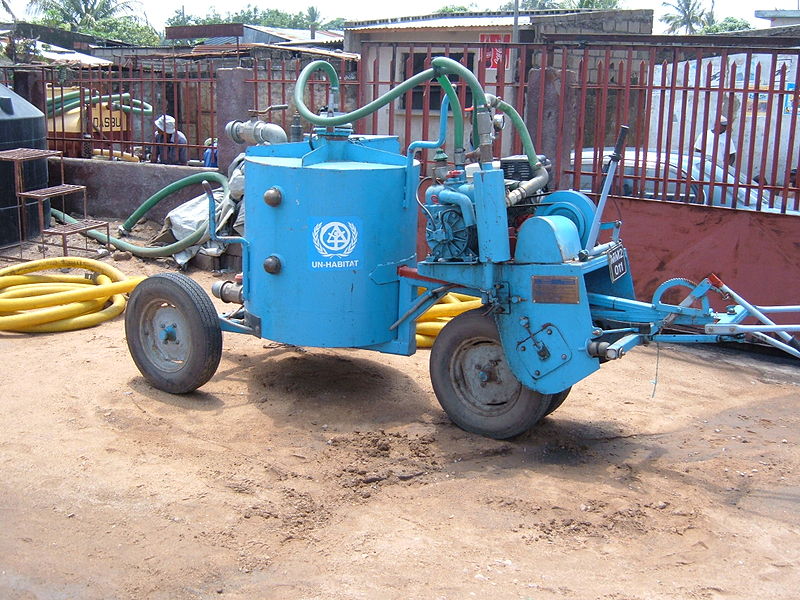
This is a small scale enterprise that UN-Habitat has been developing in Nairobi, Kenya. It is called 'Vacutug' and is a latrine emptying service.
The UN-Habitat site reports that the technology is "being constructed in association with a private-sector engineering company and a Kenyan water NGO. The micro-enterprise earned over US$10,000 over a two-year period and employed four people."
More details of the project can be found in this powerpoint presentation.
There are a number of reasons I like this business: the health and social class benefits of not using manual pit latrine emptying, the health benefits of proper sanitation, the rise in quality of life from proper sanitation, the market size due to the trend of urbanization, the need for the service is high density urban areas or squatter settlements where the walkways are too narrow for a regular sized tanker to reach, and the technology being specifically designed to be affordable and manageable for a microentreprenuer and the possibility for employment. Startup costs look to be around 5,000 per Vacutug.
This organization caught my eye because it is attempting to implement the same model as an organization I am working with, namely Freedom from Hunger. It is a testament to the strength of the idea that two organizations independently saw the same need and solution. Could this be for microfranchising what Accion and Grameen were for microfinance?
It is not clear from their website where they are in the implementation process. It also does not mention where they are working but I understand it is in Uganda.
Some of LivingGoods strengths as I see it, which are also in the FFH model:
Living Goods focuses on a short list of diseases that account for over two thirds of mortality and can be prevented and/or treated at very low cost.
Living Goods employs all the key characteristics of successful franchises: methodically screened agents, strict quality monitoring and follow-up training, uniform branding and product mix, effective promotions, low cost of goods achieved through scale, and stiff penalties for violating the rules (including expulsion).
Depending on local circumstances it may operate as a highly efficient non-profit social enterprise, as a contractor to government health ministries, or even as a for-profit business.
Living Goods will partner with local community groups, NGOs, FMCG distributors, and Microfinance organizations to source, screen and possibly finance Mobile Health Promoters.
When I was doing research in Ghana in 2006 about the 'bothersome' health problems that cut down on women's productivity one of the most reported problems was 'waist pains' or, what we in the U.S. would call, lower back pain. Although not a physician, my diagnosis was that the problem was a result of the way women lifted heavy items, i.e. bending at the waist instead of using their legs. One of the most common items lifted in this way to be put on the head for carrying was water.
The Hippo Water Roller is a simple, easily manufacutred product that can increase productivity by decreasing the amount of time expended to gather water and by decreasing the number of sick days or shortened work days due to lower back pain. Hippo Water Roller has franchised a production facility that could be set up in a myriad of locations. There is a link on the website for contacting them about specific costs and setup.
I think this is another example of a simple business that could piggyback on the structure of microfinance. Clients could use their loan to buy the Hipporoller franchise. I wonder how actively HippoRoller is promoting their product and if they are trying to sell their franchised production facility to microfinance institutions to then sell to their borrowers.