Showing posts with label Favorites. Show all posts

Friday, September 26, 2008

Kiva should co-brand with microfranchises


I have been a fan of Kiva from their early days. They had another recent surge of success when they introduced Group Lending and Partial Loan Repayments, both brilliant moves in my opinion on multiple fronts: driving consistent traffic to their site, engaging their citizen base in a frequent and meaningful way, and leveraging natural networks.

However, I am still anxiously awaiting the day when Kiva moves into the next realm of innovation, when they are using their platform to strategically inspire change in the market. Right now they are focused exclusively on microcredit and simply support the normal activities of their partners and the microcredit borrowers. It could be argued that that is their expertise and value-add, however, I do not see the innovation nor the value of Kiva as a funder of microcredit, which is partly why I agree with people who say that Kiva should not be focused on providing a financial ROI for lenders. Even if Kiva continues on their projected growth their financing of microcredit will be minuscule compared to the capital being raised for microcredit through integration in the financial markets and through microcredit accelerator's such as Unitus.

The innovation of Kiva is that they have created a platform that allows a broad base of average citizens to become miniature philanthropists. Kiva has never had to spend a dollar on marketing, people find Kiva and become inspired: bloggers picked it up early, when people find Kiva they blog about it, they showcase their loans, Kiva even had to create an entire site, KivaFriends, to handle all the interest of their constituents to discuss the issues.

Therefore, as a platform and in the position of inspiring and shaping grassroot philanthropy I think Kiva is extremely well-positioned to strategically shape the local marketplace of their borrowers. One way they could shape the marketplace would be to partner with microfranchise operations. Kiva could be the platform, the broker, that connects microcredit organizations with the best microfranchise solutions, and then together they offer a financing mechanism for the expansion of new business and innovatin in the marketplace.

This would provide value to the microcredit borrower, providing them a new business model, a great potential source of income as opposed to simply increasing their inventory in the same business as their neighbor. It would provide value to the community in which the microcredit borrower lives, bringing a service such as VisionSpring eyeglasses or HealthKeepers pharmaceutical products or a technological product such as Kickstart's waterpump. It could probably be structured so that the MFI gets a cut as a distributor of products. Kiva could provide value to these fantastic innovations by being a catalyst for the best models. It would provide value to the Kiva Lender because they would feel they are being innovative in their lending and philanthropy.

Kiva needs to think beyond scaling up microcredit and more about being a platform for change.

Sunday, March 23, 2008

OneRoof swinging for the fence

OneRoof is a for-profit social enterprise that seeks to deliver 9 essential services in one franchised operation: Information Tech. and Communications, Financial Services, Education, Energy, Health, Clean Water, Sanitation, Agricultural Technologies, and Employment Generation.

I heard Jennifer Ellingson, a senior associate, give a presentation about OneRoof at BYU last November and was quite impressed. They currently operate 20 stores themselves in Mexico and India, having yet to sell franchises outright. I would consider them to still be in the testing phase of operations and launch although I believe they have raised a significant amount of money for their initial growth. I think the are finding very different challenges in Mexico and India which is modifying their model. Looking over their website it appears that they have been able to attract a very talented team which bodes well.

I like their model of being a broker of services as far as being a branded location that can be a point of distribution for a number of partners instead of providing all the services themselves. I have no sense of how well they are delivering on their mission, I have not seen them in the press much and their blog has not been updated since they secured their second round of funding. Their aim to function completely as a for-profit venture will make them an interesting case study in evaluating the feasibility of Gates' creative capitalism and Yunus' social business.

Regarding not knowing their current status: what do you think about transparency and reporting in the citizen sector? How much should social businesses report about their struggles?

Wednesday, November 14, 2007

Freedom from Hunger pilots HealthKeepers: Preventative Healthcare in a Basket


I'll start with Freedom from Hunger and their MicroBusiness for Health Initiative. I, of course, am biased towards this project as I was involved in the needs assessment which turned out to be my main graduate work. Ellen Vor der Bruegge was the presenter.

Quick summary: Preventative health products in a basket sold by an microcredit borrower in rural Ghana patterned after the Avon or Tupperware models that were successful in rural America beginning in the late 1800's.

FFH could be considered the new kid on campus, they are just launching their program. They have put together a team of ladies to pilot the business and provide feedback. The name of the business is HealthKeepers and I like the fact that the women sellers chose the name for the business. As expected, they sell insecticide treated nets, condoms, and ORS packets with zinc but they also sell a handful of products, which Ellen called their “door-openers”. What would you guess is their biggest seller? Now, this is a region where malaria is hyperendemic, polio still exists in pockets, and children die everyday from ailments such as diarrhea. The answer, drum roll.... athlete's foot powder. That in and of itself is amazing--no traditional public health intervention would focus on athlete's foot, yet, market feedback identified a quick and simple product that is viewed to have high value in terms of quality of life. I think the key is that they experimented, they put something out there and let the market respond. If athlete's foot cream gets the customers attention which allows the HealthKeeper to explain the cost-benefits of investing in an insecticide treated net then I hope they become the largest distributor of athlete's foot powder in the world. I also liked that they gave free products to their entrepreneurs to try out, creating converts of the products, and subsequently creating a very convincing sales force. They also allow the seller to give away some products in the village to stimulate demand. I also liked that they try to source products locally.

Some of their challenges: Pricing--so that all parties in the value chain are sustainable. They are constantly trying to balance their three goals: increased health protection, providing a living wage for the entrepreneur, as well as create a sustainable business themselves as the franchisor. Another main challenge, and it was echoed by other presenters, is free handouts by other programs. There must be dialogue between the various NGOs and government entities working to fight malaria. I personally feel that it is better to sell the nets, that it will be perceived with greater value, that it is more likely to be used and maintained, that it will lead to consistent supply and greatest penetration.

They are aiming high looking to have 4-5,000 HealthKeepers covering all of Ghana. I'm excited to watch their business grow over the next couple years. As they say at FFH, Onward!

Concept Paper
Blog Discussion among HealthKeeper staff
Chat with field director

Thursday, August 23, 2007

Vote for Scojo Microfranchise as a finalist at Changemakers


Scojo Vision Entrepreneurs has been selected as a finalist for the Disruptive Innovations in Health competition at Changemakers. I have highlighted Scojo on this blog as one of my favorites and know they are prominent examples in Micfranchise publications. Voting is open until August 29th.

The entry for Scojo also details their delivery model and financial model with a level of detail that is hard to find elsewhere.

I will also point two other microfranchise models that were not selected by the judges to be finalists. One is Freedom from Hunger's MicroBusinesses for Health for which I personally conducted early research. The other is Honey Care Africa which was one of my first posts.

Friday, May 18, 2007

Bicycle Vendors spreading Nutrition


When I was in Ghana last summer I often patronized Fan Milk bicycle vendors for an afternoon ice cream treat. They represent a highly successful microfranchise model. Fan Milk itself has total assets of US $17.4 million, provides indirect employment to over 8,000 and was awarded the "Business of the Century" Award at the Millennium Excellence Awards in Accra.

An individual can become a vendor for US $22 which goes towards purchasing the bike. They sell a simple line of products, namely yogurt, chocolate milk, ice cream, and fruit popsicles. Each day the vendor buys US$33 of inventory and can make an average daily profit of $5.50 (even higher in the dry season). Vendors have the option of returning the bike if they leave the company. Vendors average 8 years with the company. Vendors can move up in the company or purchase additional bikes and sub-lease them out to new recruits.

As the franchisor, Fan Milk provides free equipment repair, biannual training on product handling and hygiene. They provide the option of health insurance to vendors. They require US$.55 per day in forced savings, which Fan Milk distributes when they leave the company.

This example has so many social benefits: environmentally friendly bicycles, high nutritional product distribution, positive employee packages (insurance, education, etc) and a high provider of employment. My major criticism of the model would be the amount of trash generated and littered from the individual packets. After plastic water sachets, the bright pink Fan Milk packaging was the most common site of trash.

This model reminds me of a couple other projects:
The recent Grameen-Danone yogurt partnership highlighted onDefeatingGlobalPoverty.

Design for the Other 90%exhibit in New York, Transportation section.
Practical Action's collection of bicycle modifications and trailers as well as the idea of a bicycle ambulance.

I think the bicycle vendor model as a microfranchise can be applied to so many different products.

Tuesday, April 03, 2007

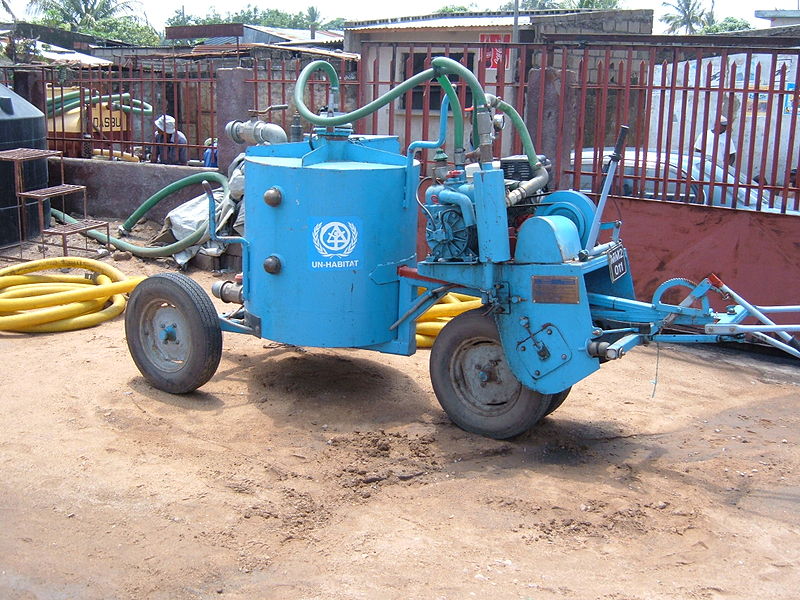
Vacutug for Urban Sanitation


This is a small scale enterprise that UN-Habitat has been developing in Nairobi, Kenya. It is called 'Vacutug' and is a latrine emptying service.

The UN-Habitat site reports that the technology is "being constructed in association with a private-sector engineering company and a Kenyan water NGO. The micro-enterprise earned over US$10,000 over a two-year period and employed four people."

More details of the project can be found in this powerpoint presentation.

There are a number of reasons I like this business: the health and social class benefits of not using manual pit latrine emptying, the health benefits of proper sanitation, the rise in quality of life from proper sanitation, the market size due to the trend of urbanization, the need for the service is high density urban areas or squatter settlements where the walkways are too narrow for a regular sized tanker to reach, and the technology being specifically designed to be affordable and manageable for a microentreprenuer and the possibility for employment. Startup costs look to be around 5,000 per Vacutug.

Wednesday, March 07, 2007

Reading glasses for the Poor


I was first introduced to the idea of microfranchising when I attended a lecture by Dr. Jordan Kassalow at the Economic Self-Reliance Conference in 2006. Scojo remains one of the leading organizations in developing a turn-key, 'business-in-a-backpack' model.

Scojo delivers reading glasses to the nearly one billion people worldwide who have blurry near vision (presbyopia). From a profile on ChangeMakers: this group of people need reading glasses to see up-close to sustain their livelihoods and maintain their quality of life (reading religious texts, separating stones from rice for daily meal, differentiating seeds types). Millions worldwide lose their livelihoods every year due to a lack of access to this affordable product.

I think some of the particular elements of success for Scojo have been:
1. Partnering and Networks from the parent company Scojo Vision LLC
2. They kept the model simple, selling reading glasses, and simply referred other issues.
3. Offering high incentives to their franchisees
4. Willingness to train others to replicate their system. Thus creating a macro-franchise on top of the microfranchises.
5. Offering multiple products in color, durability, etc. (I think this needs to be adopted by other operations such as selling mosquito nets)
6. Piggybacking on top of the infrastructure of microcredit institutions.

Scojo is in the process of scaling up and allowing more partners to launch their model.

What have been people's experiences with Scojo?

Here are some video clips giving an overview of Scojo and a feature on NBC Nightly News

Monday, February 12, 2007

Honey Care


  • Honey Care is a rapidly expanding social franchise in Kenya that trains farmers in commercial beekeeping and buys their honey at guaranteed fair-market prices which it then packages and sells for profit.

    Startup costs: US$65 per hive. Typical start with four hives.
    Breakeven: investment pays for itself in 2-3 years
    Impact: 4 hives, 20 minutes a day can result in $150-$300 additional income.

    Keys to success: Low start-up costs. Simple. The company manufactures a special design/high yield beehive. Activity compliments and function in harmony with existing farming practices. Low amount of required input as far as land, labor or knowledge. Partners with MFI's to finance startup costs for individual. Encouraged farmers to put their hives next to each other, increasing the quality of the collective bee colony as well as creating a support system for their clients. Trained in basic math/record keeping. In some cases hives are leased rather than purchased so that in the case of default the asset can be recovered and put into use by another client.

    Threats: most failures due to lack of training or access to ongoing support, often result of unsure responsibilities between Honey Care and the MFI. Must be placed near proper vegetation. Long wait from initial investment to first harvest. Threat of bee stings : )

    I think the guaranteed purchasing of the product goes a long way in building trust and encouraging recruitment of potential clients. Some clients reported being able to sell the honey at a higher price locally than the price offered by Honey Care, in such a case I think Honey Care should allow the clients to sell a certain percentage of their honey locally. My main question is: who is the final buyer of the honey? Can it be competitive in Western markets? How do we get it in Walmart?

  • MTN Village Phone


  • MTN Village Phone


  • MTN Village Phone is an initiative of Grameen Foundation USA in Uganda based on successful Grameen Village Phone company in Bangladesh.

    The franchise funcitons with four partners: the telecommunication provider, an MFI, the Village Phone company, and the Village Phone Operator (VPO)
    Start-up costs: US$240
    Break even: after 26 weeks assuming 17 minutes airtime per day.
    Impact: Income to Village Phone Operator, entire community access to information that can enhance income opportunities, improved access to health care/emergencies, connection to be informed of pending natural disasters

    Keys to success: the strength of the partnerships, particularly with the MFI to provide start-up capital, did not limit number of sellers per area allowing the market determine demand and not allowing monopolies. No modifications in loan dispersement was required of the MFI. Incentive program for middle men to sell airtime.
    Threats: ease of entry for competition, electricity blackouts