Showing posts with label Books. Show all posts

Monday, May 11, 2009

MicroFranchise Toolkit available again


I received a notice today that the MicroFranchise Toolkit, published out of BYU's Center for Economic Self-Reliance, is available again for purchase after selling out of the initial printing. I do not receive any kickbacks for promoting it but I did think the announcement was post-worthy because of the apparent level of demand for this product.

Have any of my readers used this toolkit? Any reviews or insights?

Thursday, September 18, 2008

MicroFranchising book now available in paperback


I just received a notice that the book, MicroFranchising: Creating Wealth at the Bottom of the Pyramid, is available in paperback.  It is included in my recommended readings link; the paperback version is the one without the picture. 


 I'm excited and I know the authors are excited because it will make the information accessible to a much wider audience.  I thought it was unfortunate that the original publisher put such a high price tag on the book as part of their strategy to target university libraries.  Now, at a more reasonable price for the general consumer, I think the conversation can really begin.   The book really is a great collection of theory based articles coupled with profiled case studies.  The material in that book has been the starting point for many of my own wandering thoughts on this blog.  Happy reading.

Wednesday, December 05, 2007

New Book: MicroFranchising Toolkit


A new book has come out called the MicroFranchising Toolkit. It appears to be a handbook aimed towards those without a business background who nonetheless are interested in systematizing their projects into a franchise. It provides templates for ledger books, rules for branding, etc.

I have not had a chance to go through the book but my first reaction on hearing the concept was-- yes, it's good to have a simple clear-cut guide but don't define everything so much so that practitioners will try to force the model on a situation where it is not well-suited. (The whole square peg in a round hole analogy.) Guide-yes. Helpful-yes. A cookie cutter solution that if you follow you will automatically be successful-no.

I would be interested in reading reviews from anyone in the comments.

Thursday, September 20, 2007

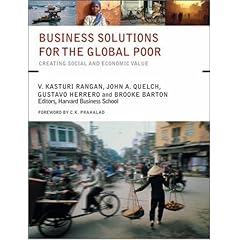
Book: Business Solutions for the Global Poor


I found this to be most nitty-gritty, detail-filled collection of case studies for business operations at the Bottom of the Pyramid. It was published after Havard Business School's Conference on Global Poverty: Business Solutions and Approaches in December 2005. A small sampling of chapter titles gives an idea of the valuable information presented: "Understanding Consumers and Retailers at the Base of the Pyramid in Latin America", "Creating a Market for Affordable Housing", "Viable Business Models to Serve Low-Income Consumers: Lessons from the Philippines". There are used copies available through Amazon.

It would be impossible to include all the specific insights I gained from this read. I read the book thinking of my own projects and, time and time again, found specific examples of businesses that developed innovative ways to overcome the same problems I face. If not the same problems, it at least forced me to ask myself questions if I was ready for the problems ahead. I would therefore recommend the book to managers and entrepreneurs who are beginning projects at the BOP for a one-stop overview of what has worked before and to get a feeling for the mentality that will lead to success.

For more details from the conference abstracts and powerpoint slides are available through Havard's Social Enterprise Initiative website.

Friday, June 29, 2007

Book: Capitalism at the Crossroads


I've been out of the loop lately as I haven't had access to the Internet while traveling, but I'm back now and the quest for knowledge continues.

Stuart Hart's Capitalism at the Crossroads is another one of those essential reads for people interested in business solutions to global poverty. In my mind his fundamental messages are:
1- Business has the power, capability, technology, and financing to best address the modern issues of climate change and poverty
2- However, current business practices must fundamentally transform if they are to be successful at the BOP.
3- We have the opportunity to "start fresh" when bringing global capitalism to the BOP and can decide to apply sustainable methods and technologies from the get-go
4- Product design, services, and delivery must be tailored specifically to the poor
5- Appropriate design will require the input of the poor themselves
5- Disruptive solutions will come in small packages

His recommendations have some implications for our current topic of microfranchising. The term 'franchising' could be interpreted to imply a single solution package that will be replicated exactly the same all over the world. This would be in conflict with Hart's idea of becoming "indigenous" and adapting to local conditions from the bottom-up. I think there can be a balance. The benefits of microfranchising are the systems, training, quality management, and lower costs it could bring to the informal market. However, when designing a microfranchise, practitioners must be prepared to be flexible and take cues from the local community and end users in refining business models. I think it will require more than simply changing the product basket, such as the modifications McDonalds makes in their menu in India or in Muslim countries. There will need to be fundamental changes in product design, marketing, purchasing plans to make them appropriate for the BOP. There are a number of publications now available including Next4Billion and a paper on the Economic lives of the Poor, that are shedding light on the unique economic behaviors and decision making of the poor. Such information will help us better anticipate some of the challenges of working at the BOP. I also think development of successful microfranchises will be an organic process. I would get something out there and let the market/local context refine it before I package it and implement it on a large scale.

In his book Hart is trying to get the attention of MNC's and I agree that if they really caught this vision then they are in a wonderful position to make a huge impact on the world in a relatively short amount of time. However, I anticipate that reaching the BOP will be more along the lines of the disruptive technologies Clay Christensen has written about. I think there are two groups of people that are converging at the same time that could potentially be the entrepreneurs to introduce such solutions: retiring baby boomers who have wealth and want to make a difference but perhaps not the full energy or desire to start something from the bottom-up and college-aged students who are more globally orientated than ever before and who are looking to make a difference in the world instead of simply chasing wealth. I think the marriage of these two populations has a great potential to produce solutions for the BOP.

I also like his emphasis on the small and simple. In the West, technology is all about the latest and greatest with the most bells and whistles. It will take restraint and perhaps more creativity for designers to produce products with a priority for simplicity, functionality, and ultimate low costs. When considering the crossroads at which we stand, I am optimistic that we will rise to the challenge and design the course correction that capitalism needs in our modern times.

Tuesday, May 15, 2007

Book: How to Change the World


David Bornstein's How to Change the World is a must-read for anyone dabbling in the field of social entrepreneurship. The book presents numerous case studies of Ashoka fellows centered around Bill Drayton who has systematically found, supported, and promoted them. However the most insightful sections are provided by the author as he provides observations regarding patterns and common charateristics such as "Four Practices of Innovative Organizations" or "Six Qualities of Successful Social Entrepreneurs".

I find this book appropriate to highlight on this blog because the author's final call to action is to promote "Blueprint Copying", a phrase borrowed from Diamond's Guns, Germs and Steel. Bornstein argues that the social sector has heretofore done well at 'idea sharing' and 'knowledge diffusion' but have not quite harnassed the power of "blueprint copying". I propose our present topic of microfranchising is none other than a version of blueprint copying.

One thing I came away with, and it relates to this concept of blueprint copying (microfranchising), is that these leading social entrepreneurs are truly remarkable individuals with incredible drives to see their vision come to reality. However this feeling of the power of a single highly motivated individual is coupled with a hope that their great visions can be replicated and expanded by perhaps the next tier of entrepreneurs through 'blueprint copying'. His final statement is similar to my vision of this blog, "the opportunities are endless--and they are just beginning to be seen."

Thursday, May 10, 2007

Definition Clarification


I have recently had the opportunity to get a sneak peek at the first major publication on microfranchising that is coming out in July. I thought I would pass on the authors' definition of microfranchising as the definition page is one of the most frequented on this site. Some quotes:

“The underlying intent of a microfranchise is to alleviate poverty through the creation and provision of sound, proven businesses that will in turn increase the earning potential of the microfranchisee. Microfranchises are independently owned and operated; thus,they create income for the individual owner and the owner’s employees, while simultaneously providing needed goods and services at an
aordable price.”

“the “micro”in microfranchising stands for more than mini or small.“Micro”is essential to microfranchising and in this sense has a social connotation that refers to grassroots bottom-up
initiatives, poverty alleviation, benevolence, base ofthe pyramid,and the like. “micro”also represents
sustainability. Thus, microfranchising can be thought of as poverty alleviating, social, grassroots, BOP, benevolent,and barefoot franchising.”

“The franchise in microfranchise represents replication to scale. This involves systematizing an operation, paying close attention to each and every aspect of a business until it is a turn-key operation, then replicating it to scale. Franchising embodies the concept of granting the right, privilege, or access to a proven business system.”

“The marriage of the two terms makes up microfranchising, which is indeed very different from franchising. For example,in traditional franchising, the purpose for establishing a franchise is to grow one’s business quickly in order to increase profits. In microfranchising, the focus is more on the microfranchisee and how he/she benefits from buying into a proven systematized business. A microfranchise is established to assist the poor in creating a sustainable income through owning
and operating their own business. The reduction of risk, provision of specific training, ongoing mentoring, and reduction of creative burden are all benefits to the microfranchisee.”

The book goes on to discuss the theory of microfranchising, potential business models, case studies, financing tools, and a concluding outlook to the future. I look forward to discussing the ideas in the book after its release.

Sunday, April 22, 2007

Book: The Elusive Quest for Growth


I might be a little behind as this book was published in 2001 but I found it while searching for his more recent work and found it extremely insightful. It is macro-level, economist view but the principles have applications at all levels.

Easterly's predominant theorem is that "people respond to incentives", whether those people are the poor, government officials in a poor country or rich donors in developed countries. I think the strength of the idea of private enterprise, be it microfranchising or other ventures, at the bottom of the pyramid is built upon the idea of incentives, namely profit incentives.

The other element of Easterly's work that really stuck out to me was the need to say no to corruption and poor government by voting with our aid dollars. When considering where to set up shop I think we all need to consider the International Country Risk Guide and reward those countries that are making policy and judicial decisions that show that the leaders are dedicated to the plight of the poor and the growth of the entire country and not just their own pocketbook.

And of course his emphasis on technology that improves productivity is particularly in line with the kind of businesses I propose on this blog. I would add an emphasis on technology that is tailored to the conditions of the poor.

Good read, I'll report on his latest book when my hold comes through from the library.

Monday, January 22, 2007

Teaching Microfranchising


Brigham Young University's Center for Economic Self-Reliance publishes a handbook entitled Where There Are No Jobs that is a how-to manual for teachers to teach individuals in developing countries how to successfully start and run microenterprises. The main author is an entreprenuer, Steve Gibson, who in addition to his personal financial success, has created a business school for microentreprenuers in the Phillippines called The Academy for Creating Enterprise. The handbook is a result of lessons learned from Steve's development and refinement of the Academy. It focuses on core business principles that seemed to elude his budding entreprenuers. The handbook is also prepared with lesson plans (that use the case study method) for organizations who want to combine business education with such programs as microcredit.

Microfranchising became part of Steve's operations as he monitored the businesses of early graduates, identified successful businesses, and then helped to replicate those businesses according to a franchise model. Graduates of the educational program now do not necessarily have to go through the process of creating a new business and launching it, they can purchase a franchise of one of the successful models and off they go.

The fourth book in the series of "Where There Are No Jobs" is one of the first publications focusing on franchising in the informal markets of poor countries with extremely practical guides and lesson examples of how to teach good business principles to small enterprise owners. I would look for Brigham Young University to continue to publish works that focus on Microfranchising. I think many microfinance institutions would be interested in the concept of microfranchising and offering them to their clients. A successful business model would be a less-risky investment and perhaps their clients would see less business failure.