E-Health Clinics in India
This is a health clinic in rural India using an interesting combination of clean water and e-healthcare. This business is being incubated by Ashoka, here is the original press release.
This is a health clinic in rural India using an interesting combination of clean water and e-healthcare. This business is being incubated by Ashoka, here is the original press release.

Florence Cassassuce was a CNN Hero finalist and a World Bank Development Marketplace winner and according to an entry from a Changemakers competition last year, her next step is to turn her UV water purification bucket into a micro-franchise business based on the VisionSpring's model.

I was introduced to another communication center microfranchise called EasySeva in Sri Lanka similar to the n-Logue or ONE Roof models I have covered previously. I was informed they have 23 outlets and expect to have 55 outlets by the end of the summer. It is a private, for-profit Sri Lankan company with a holding company in the U.S. but the seed funding was awarded in a contract with USAID. The model of EasySeva relies on corporate partnerships to actually provide the services, including Dialog Telekom, Qualcomm, National Development Bank, Lanka Orix, and Microsoft. They are also working in collaboration with the business school at USC. After proving the model they will seek private investment.
 OneRoof is a for-profit social enterprise that seeks to deliver 9 essential services in one franchised operation: Information Tech. and Communications, Financial Services, Education, Energy, Health, Clean Water, Sanitation, Agricultural Technologies, and Employment Generation.
I heard Jennifer Ellingson, a senior associate, give a presentation about OneRoof at BYU last November and was quite impressed. They currently operate 20 stores themselves in Mexico and India, having yet to sell franchises outright. I would consider them to still be in the testing phase of operations and launch although I believe they have raised a significant amount of money for their initial growth. I think the are finding very different challenges in Mexico and India which is modifying their model. Looking over their website it appears that they have been able to attract a very talented team which bodes well.
I like their model of being a broker of services as far as being a branded location that can be a point of distribution for a number of partners instead of providing all the services themselves. I have no sense of how well they are delivering on their mission, I have not seen them in the press much and their blog has not been updated since they secured their second round of funding. Their aim to function completely as a for-profit venture will make them an interesting case study in evaluating the feasibility of Gates' creative capitalism and Yunus' social business.
Regarding not knowing their current status: what do you think about transparency and reporting in the citizen sector? How much should social businesses report about their struggles?

Over the last couple months I have been an intern at Ashoka promoting their Citizen Base Initiative. One of my favorite stories I've had to work with has been DMT Toilets in Nigeria.
 Although I do not have direct contact with Living Goods I have always been interested in their work as the concept is nearly identical to the HealthKeepers of Freedom from Hunger, the market research for that business being the topic of my graduate thesis. I am anxious to see how the models mold as they are refined on the ground. This is a recent update from Chuck Slaughter, the founder and president:
Friends of Living Goods,
Living Goods, known as the “Avon of Rural Health”, is delighted to share the following milestones from this last fast-paced year on our journey to becoming the first fully sustainable system for defeating the diseases of poverty:
• Last May Living Goods and BRAC signed a joint venture agreement to collaborate on building a Living Goods network serving 20+ districts in Uganda.
• The Rockefeller Foundation, Mulago Foundation, Causal Fund and the Horace W. Goldsmith Foundation each awarded core funding to Living Goods.
• Extensive research, field study and customer focus groups helped LG identify its first 28 health products which are now in stock across the LG network.
• In a sizable launch, Community Health Promoters were carefully selected, trained equipped and deployed to serve 200 communities.
• Poverty Action Lab began helping Living Goods design a best-of-class randomized evaluation system to measure LG’s key objectives of dramatically reducing mortality and fertility rates.
• Harvard Business School and the Harvard School of Public Health selected Living Goods to participate in their Project Antares field study.
• Living Goods was awarded an exclusive Draper Richards Fellowship.
• Most recently Living Goods began developing plans to market low cost solar lanterns and high efficiency cook stoves to help poor households dramatically reduce fuel expenses and indoor pollution.
• Chris Elias- President of PATH, Paul Polak - Founder of IDE, and Erastus Kibugu of Technoserve Uganda joined the Living Goods Advisory Board.
We extend our sincere thanks to all who helped LG reach this important juncture. In particular we want to acknowledge the BRAC Uganda team and their exceptional director Mr. Khondokar Ariful Islam. Their commitment, experience and professionalism are unmatched and indispensable.
Of course this is just the beginning. We will add 300-500 more Health Promoters before the end of the year, and scale to 3,000+ in four years serving four million people in Uganda alone. In the coming years LG plans to replicate this model across the developing world with other world class partners and test expanded product offerings in clean water, power and small holder agriculture. In fact a half dozen multinational NGOs are already expressing keen interest in collaborating with LG to implement its innovative system in other countries.
Naturally, along with these opportunities abundant challenges lie ahead. Living Goods represents a disruptive innovation in rural health care that will require considerable trial and error. Building a truly sustainable, replicable business model will be one measure of Living Goods success; the far greater success will be counted in the many diseases prevented, the many children saved, and the many healthy productive years families will enjoy by virtue of having affordable essential medicines within reach.
Please feel free to contact me directly (cslaughter@livinggoods.org) if you have any questions, or are interested in partnering with or supporting Living Goods.
To Your Health,
Chuck

Today as I was driving I listened to an old podcast from GlobeShakers from the Stanford Center for Social Innovation, the guest speaker being Don Gould speaking about Pure Water for All.
In the interview Don describes a microfranchise model for manufacturing and distributing the ceramic water filters. It sounds like a great model: using locally available materials, creating jobs for local communities with a tremendous social return on investment. This interview was back in 2005, does anyone have an update on their project?
The latest issue of the Stanford Social Innovation Review has an article about microfranchising. It is written by Jessica Flannery, co-founder of Kiva, which I have always been a fan, and highlights the story of Scott Hillstrom and his HealthStore Foundation which helps finance CFWShops in Kenya. I believe Scott Hillstrom is also behind the pilot microfranchise Living Goods.
The article provides a lot of interesting history and details of the CFW Shop experience.

This post is from NextBillion:
"I'm very happy to announce the release of the WRI business case study, What Works: Mi Farmacita Nacional, authored by Enrique Coronado ('08), Christina Krettecos ('07), and Yvonne Lu ('07) of Columbia Business School.
Mi Farmacita Nacional, a fully for-profit pharmacy franchise, is among the first retailers of generic medications to serve low-income communities in Mexico. Mi Farmacita was launched in 2003 and has since more than doubled its number of outlets every year to reach 57 outlets as of March 2007. Outlets in operation for a minimum of 22 months are now processing an average of 2,400 transactions/month in sales of affordable medications, doctor consultations, filtered water, telephone access, and other essential products and services.
What Works: Mi Farmacita Nacional analyzes the business strategies that have enabled Mi Farmacita's rapid growth and success in serving low-income communities.
This case study was made possible through the generous support of the Horace W. Goldsmith Foundation and Social Enterprise Program at Columbia Business School."
A couple thoughts as I read through the Case Study:
I find it interesting that the business is purely for-profit and is the joint effort of two large companies in an effort to tap a new market and not necessarily a social enterprise that started off with the goal of helping the poor. I would place it under the philosophy of the "Fortune at the Bottom of the Pyramid" folks. I think they have great potential to bring essential goods and services to the poor but I would also like to see a system of checks or audits to ensure that they will stay socially responsible as they deal with the poor.
I like their goal to be "accessible by foot" as they choose store locations.
I like the inclusion of phone and internet health services which they cite as significantly increasing store traffic.
I found it interesting that 70% of franchisee recruits reported the company website as their source of discovery of the business opportunity.
I looks like helping potential franchisees finance their startup costs is the major barrier to accelerated growth at the present time.
I'll be interested in following their progress in the near future.

Vodacom provides phone and fax services to the poor throughout South Africa via phone kiosks set up by Vodacom and operated by a franchisee. In 1993, Vodacom was issued a license to operate in South Africa with specific requirements that involved providing services to the poor who either had limited or absolutely no access to phone lines. Vodacom accepted the challenge and has set up approximately 22,000 phone lines scattered among 5,000 kiosk sites. A kiosk receives a wireless signal which is directed to stationary phones in a renovated shipping container.
Vodacom seeks out entrepreneurs who own and run the kiosks. Vodacom began by tracking cell phones with abnormally high numbers of calls each month. Vodacom perceived that these people were self-motivated entrepreneurs selling air-time. After identifying the natural entrepreneurs, Vodacom trained them how to manage a mobile kiosk. Vodacom no longer has to recruit franchisees; businessmen/women now come to them seeking franchises.
The total cost of setting up a phone kiosk is $7,400; however, Vodacom assumes a greater portion of the costs and leaves the franchisee with a cost of approximately $3,400. Vodacom builds the kiosk and the franchisee is responsible for the equipment and transportation costs. Initially, Vodacom provided loans, but demand for franchises has grown so rapidly that they now have enough franchise applicants that they are able to select people who already have financing.
Total revenue from Vodacom’s 5,000 kiosks was $129.5 million in 2003. Vodacom receives 2/3 of revenues and the franchisee retains the other third, resulting in a gross profit on average of $38,800 a year. This model is a MFO paragon, demonstrating the third MFO hypothesis that a MFO should provide jobs as well as create entrepreneurs. Vodacom kiosks employ an average of 5 people per shop. Currently, the demand for kiosks is greater than Vodacom’s ability to develop them.
Source: BYU Center for Economic Self Reliance
There is also an extensive case study prepared by WRI
These Vodacom shops really show the potential of microfranchises in terms of providing employment, delivering essential services, and being highly profitable for the franchisor. Considering the higher startup costs, the franchisees of Vodacom shops are not the same target market as the Grameen Phone ladies or similar operators, but I actually think employment holds more potential to help poor families than forced self-employment.
Considering all the essential products and services that are unavailable to the poor, shouldn't we be inspired by the fact that one can purchase a Coke in nearly every village on the earth. Coca-Cola is a brilliant model of systems of suppliers, distributors, wholesalers, and retailers.
One of their methods could be termed microfranchising. In South Africa, Coca-Cola operates an Entrepreneur Development Program. After selecting entrepreneurs they provide training in business skills, such as managing cash flow, creating profit, marketing and following legal requirements, as well as provide access to startup capital to acquire inventory, coolers, trolleys, bicycles, etc. The program is mutually beneficial as it provides employment and education to local entrepreneurs while helping Coca-Cola gain access to undeveloped markets.
The most interesting aspect in the EDP case is that Coca-Cola originally tried to not impose marketing standards and procedures but to let it develop 'naturally' according to local entrepreneurialism. However, over time, Coca Cola saw that helping small businesses launch was insufficient, they saw a need to provide ongoing training to help them be sustainable. Compare that to the experience of microcredit which has traditionally limited its services to provide access to credit with the assumption that entrepreneurs could take the opportunity and run with it. Just as Coca-Cola saw the need to provide extra guidance, microcredit institutions should be interested in the concept of microfranchising as it can be a mechanism to provide ongoing guidance to promote sustainable livelihoods.
Source: Where there are No Jobs
I have previously blogged about my involvement in a pharmacy-in-a-box project with Freedom from Hunger as well as Living Goods and their Avon-lady sales strategy. The Health Plus Pharmacies program in Philippines is perhaps the model furthest along in terms of implementation and coverage. I wasn't able to find a presence on the web, if anyone knows of one provide a link as a comment.
It launched in 2001 as a project of the Philippines Department of Health and the GTZ German Bank for Reconstruction. The project is called the National Pharmaceutical Foundation Inc. (NPF). The NPF provides 3 franchise shops: a health plus outlet (limited product line, no required pharmacist), a Shop-in-a-shop (counter space in a government pharmacy or coop), and a Health Plus Pharmacy (full product line, full-time pharmacist and part-time doctor required). The NPF provides the business model, handles product distribution, branding, store design, and conducts performance audits.
NGO's or individuals can purchase the franchise. Startup costs for an outlet are US$400. The average franchise fee is US$156 plus .5 percent annual fee of all drug purchases.
Franchisees are able to absorb 70% of the store's income. As of June 2005 there are 317 Rural outlets, four shop-in-a-shop stores, and three pharmacies.
I think the strength of this project is the balance between government oversight and private business. The Department of Health brings key funding and management resources while the franchises themselves function according to the market, and the efforts/quality created by the owners.
I also think the multi-prong shop types gives the venture added depth. The Health Plus outlets, although offering a limited product line, can benefit from the reputation of the full service pharmacies.
Source: Where there are No Jobs vol 4

When I was in Ghana last summer I often patronized Fan Milk bicycle vendors for an afternoon ice cream treat. They represent a highly successful microfranchise model. Fan Milk itself has total assets of US $17.4 million, provides indirect employment to over 8,000 and was awarded the "Business of the Century" Award at the Millennium Excellence Awards in Accra.
An individual can become a vendor for US $22 which goes towards purchasing the bike. They sell a simple line of products, namely yogurt, chocolate milk, ice cream, and fruit popsicles. Each day the vendor buys US$33 of inventory and can make an average daily profit of $5.50 (even higher in the dry season). Vendors have the option of returning the bike if they leave the company. Vendors average 8 years with the company. Vendors can move up in the company or purchase additional bikes and sub-lease them out to new recruits.
As the franchisor, Fan Milk provides free equipment repair, biannual training on product handling and hygiene. They provide the option of health insurance to vendors. They require US$.55 per day in forced savings, which Fan Milk distributes when they leave the company.
This example has so many social benefits: environmentally friendly bicycles, high nutritional product distribution, positive employee packages (insurance, education, etc) and a high provider of employment. My major criticism of the model would be the amount of trash generated and littered from the individual packets. After plastic water sachets, the bright pink Fan Milk packaging was the most common site of trash.
This model reminds me of a couple other projects:
The recent Grameen-Danone yogurt partnership highlighted onDefeatingGlobalPoverty.
Design for the Other 90%exhibit in New York, Transportation section.
Practical Action's collection of bicycle modifications and trailers as well as the idea of a bicycle ambulance.
I think the bicycle vendor model as a microfranchise can be applied to so many different products.

“Rat catching is an occupation for many poor people in the agriculture fields of India. The 25 percent crop loss due to the rat menace is economically devastating to farmers through the country. The income of rat catchers ranges from US $15 to US $30 a month. They use a traditional earthen pot fumigation method to kill rats in their burrows. This method comes at great cost to the fumigators' health as they inhale smoke that leads to severe occupational health problems, including problems with the respiratory system, heart and eyes. A study shows 30-40 percent of the rat catchers have one or many of these health complications.
The Center for Development of Disadvantaged People has developed a technology that would eliminate these health hazards and more than double a rat catchers' income because its method is twice as efficient. The cost of the instrument in between US $20 to US $25. Eliminating rats is essential to Indian agriculture, and the distribution and use of this technology could prove not only beneficial to farmers, but also to entrepreneurs in the rat catching business. “
I like this example for the simplicity of the technology, the low start-up costs, and the ease of training. How many places in the world could benefit from this technology, how many crops could it save?
Source: Where There Are No Jobs Vol. 4

Grameen Shakti is a member of the Grameen family bringing renewable energy to rural communities. It was a 2006 Ashden award winner. I particlarly like their strategies of:
-Individual ownership for increased responsibility.
-Utilizing microcredit services to finance the purchase.
-Linking with income generating activities.
Here is a list compiled by Kirk Magleby that identifies a number of microfranchise models. I will try to research details about the individual examples.
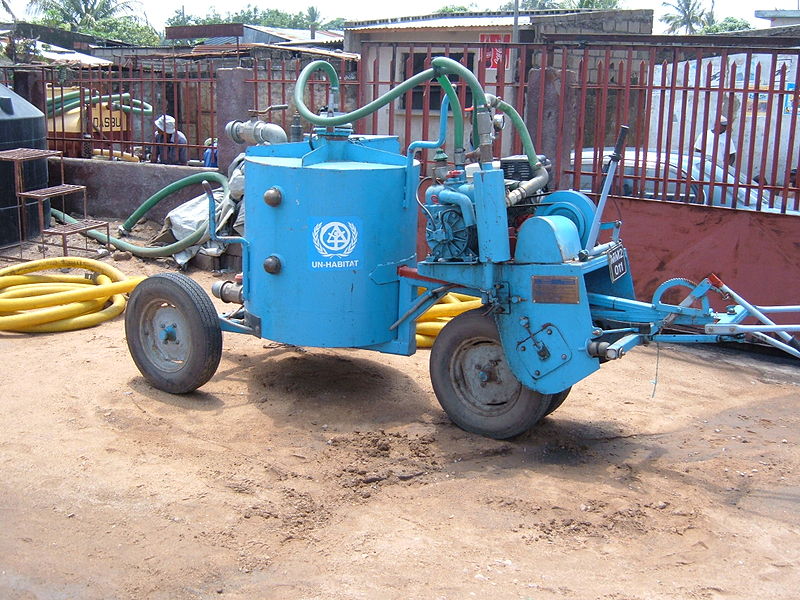

This is a small scale enterprise that UN-Habitat has been developing in Nairobi, Kenya. It is called 'Vacutug' and is a latrine emptying service.
The UN-Habitat site reports that the technology is "being constructed in association with a private-sector engineering company and a Kenyan water NGO. The micro-enterprise earned over US$10,000 over a two-year period and employed four people."
More details of the project can be found in this powerpoint presentation.
There are a number of reasons I like this business: the health and social class benefits of not using manual pit latrine emptying, the health benefits of proper sanitation, the rise in quality of life from proper sanitation, the market size due to the trend of urbanization, the need for the service is high density urban areas or squatter settlements where the walkways are too narrow for a regular sized tanker to reach, and the technology being specifically designed to be affordable and manageable for a microentreprenuer and the possibility for employment. Startup costs look to be around 5,000 per Vacutug.

This organization caught my eye because it is attempting to implement the same model as an organization I am working with, namely Freedom from Hunger. It is a testament to the strength of the idea that two organizations independently saw the same need and solution. Could this be for microfranchising what Accion and Grameen were for microfinance?
It is not clear from their website where they are in the implementation process. It also does not mention where they are working but I understand it is in Uganda.
Some of LivingGoods strengths as I see it, which are also in the FFH model:
Living Goods focuses on a short list of diseases that account for over two thirds of mortality and can be prevented and/or treated at very low cost.
Living Goods employs all the key characteristics of successful franchises: methodically screened agents, strict quality monitoring and follow-up training, uniform branding and product mix, effective promotions, low cost of goods achieved through scale, and stiff penalties for violating the rules (including expulsion).
Depending on local circumstances it may operate as a highly efficient non-profit social enterprise, as a contractor to government health ministries, or even as a for-profit business.
Living Goods will partner with local community groups, NGOs, FMCG distributors, and Microfinance organizations to source, screen and possibly finance Mobile Health Promoters.

When I was doing research in Ghana in 2006 about the 'bothersome' health problems that cut down on women's productivity one of the most reported problems was 'waist pains' or, what we in the U.S. would call, lower back pain. Although not a physician, my diagnosis was that the problem was a result of the way women lifted heavy items, i.e. bending at the waist instead of using their legs. One of the most common items lifted in this way to be put on the head for carrying was water.
The Hippo Water Roller is a simple, easily manufacutred product that can increase productivity by decreasing the amount of time expended to gather water and by decreasing the number of sick days or shortened work days due to lower back pain. Hippo Water Roller has franchised a production facility that could be set up in a myriad of locations. There is a link on the website for contacting them about specific costs and setup.
I think this is another example of a simple business that could piggyback on the structure of microfinance. Clients could use their loan to buy the Hipporoller franchise. I wonder how actively HippoRoller is promoting their product and if they are trying to sell their franchised production facility to microfinance institutions to then sell to their borrowers.

I was first introduced to the idea of microfranchising when I attended a lecture by Dr. Jordan Kassalow at the Economic Self-Reliance Conference in 2006. Scojo remains one of the leading organizations in developing a turn-key, 'business-in-a-backpack' model.
Scojo delivers reading glasses to the nearly one billion people worldwide who have blurry near vision (presbyopia). From a profile on ChangeMakers: this group of people need reading glasses to see up-close to sustain their livelihoods and maintain their quality of life (reading religious texts, separating stones from rice for daily meal, differentiating seeds types). Millions worldwide lose their livelihoods every year due to a lack of access to this affordable product.
I think some of the particular elements of success for Scojo have been:
1. Partnering and Networks from the parent company Scojo Vision LLC
2. They kept the model simple, selling reading glasses, and simply referred other issues.
3. Offering high incentives to their franchisees
4. Willingness to train others to replicate their system. Thus creating a macro-franchise on top of the microfranchises.
5. Offering multiple products in color, durability, etc. (I think this needs to be adopted by other operations such as selling mosquito nets)
6. Piggybacking on top of the infrastructure of microcredit institutions.
Scojo is in the process of scaling up and allowing more partners to launch their model.
What have been people's experiences with Scojo?
Here are some video clips giving an overview of Scojo and a feature on NBC Nightly News


