Showing posts with label Sanitation. Show all posts

Tuesday, March 11, 2008

Excellent Implementation: DMT Toilets


Over the last couple months I have been an intern at Ashoka promoting their Citizen Base Initiative. One of my favorite stories I've had to work with has been DMT Toilets in Nigeria.

A couple characteristics that jump out to me in terms of microfranchising:

  1. Issac Durojaiye's franchisees are young street boys. This is in line with John Hatch's vision that microfranchising will be for the children of microcredit borrowers, that second generation.
  2. Sourcing products locally. One of the great successes of DMT Toilets in my mind has been their determination to manufacture their products locally, having a ripple effect of economic stimulation in the community.
  3. Blending of for-profit business and partnerships with private and public sector entities. The write-up on citizenbase.org tells a bit more about their partnerships but I think this is a great example of "creative capitalism" that Bill Gates described at Davos. I love the fact that the government has recognized the superiority of DMT's deliver system so instead of going out and building their own toilets for sanitation issues they simply purchased 2000 toilets and gave them to DMT Toilets to operate. As long as the government contribution did not come with certain political strings attached I'm all for such partnerships.
  4. The power of individual 'ownership' in a franchise setting. Giving the boys complete stewardship of the operation created a higher quality overall business operation.
Could this model be replicated in other areas? Your area of operation?

Friday, May 11, 2007

A worm store


It's not everyday one can take inspiration from the movie Dumb and Dumber, but Llyod's “I've Got Worms” store could be a wonderfully simple and low-cost microfranchise in rural areas in the developing world. Vermicompost, an excellent organic fertilizer, uses earthworms to convert organic waste such as kitchen waste, animal waste, and agricultural residues into compost. A vermicomposting franchise would train franchisees to properly 'feed' the worms and how to construct proper holding containers. Franchisees could then sell worms and holding containers to their neighbors. It would not be an all-consuming business but it could be an additional revenue stream, much like Honey Care Africa beehives can be an additional revenue for farmers in Kenya. I also think it is a microfranchise that could be particularly suited for rural women.

Source: Where the are No Jobs Vol. 4

Wednesday, May 09, 2007

Latrine Designs


Two new latrine designs that I can across: the Eloo and Cemforce.

The Eloo was designed in South Africa and has won numerous design awards. It was also reviewed in the Stanford Review of Innovative Products Benefiting Humans. I could see a manufacturing plant in the main city of a poor country and then microfranchises of installation services. The U.S. distributor is Cleanup America.

Cemforce offers a few different products. The one that caught my eye was their VIP (Ventilation Improved Pit) because it advertises as being able to build in less than 10 minutes, with no special cranes or tools. I'm always a sucker for simplicity.

This is another case where the microfranchisees would more likely be installers or distributors.

Wednesday, April 25, 2007

Fridge for the Poor


This technology has been featured on AIDG, the Rolex Awards, and Treehugger.

"The pot-in-pot consists of two earthenware pots of different diameters, one placed inside the other. The space between the two pots is filled with wet sand that is kept constantly moist, thereby keeping both pots damp. Fruit, vegetables and other items such as soft drinks are put in the smaller inner pot, which is covered with a damp cloth. The phenomenon that occurs is based on a simple principle of physics: the water contained in the sand between the two pots evaporates towards the outer surface of the larger pot where the drier outside air is circulating. By virtue of the laws of thermodynamics, the evaporation process automatically causes a drop in temperature of several degrees, cooling the inner container, destroying harmful micro-organisms and preserving the perishable foods inside."

Brillant design. Simple. Affordable for the poor. Impact of Health and Malnutrition. Job Creation. As of 2005 the inventor had delivered over 90,000 pots. How many more places around the world can benefit from this product? How can we get it to them?

Tuesday, April 17, 2007

Practical Action Technical Briefs


Formerly known as ITDG (Intermediate Technology Development Group), Practical Action has collected a wide range of technological solutions that are appropriate for people at the bottom of the pyramid. Some of the greatest resources on the site are the technical briefs that give details about projects ranging from an improved donkey plough to compost toilets to bicycle ambulances. The question becomes-how can we get these products and the technical information out to the people.

Thursday, April 12, 2007

Hippo Roller Alternative


I recently came across this product called the Q-Drum which is quite similar to the Hippo Roller I highlighted in a previous post. The Q-Drum has been around since 1997 when it was in an issue of TIME. A retailer could market test the two products side by side in a given area and see which is more suitable or perhaps both would be successful products. A microfranchise in association with this product would be a manufacturing operation.

Tuesday, April 03, 2007

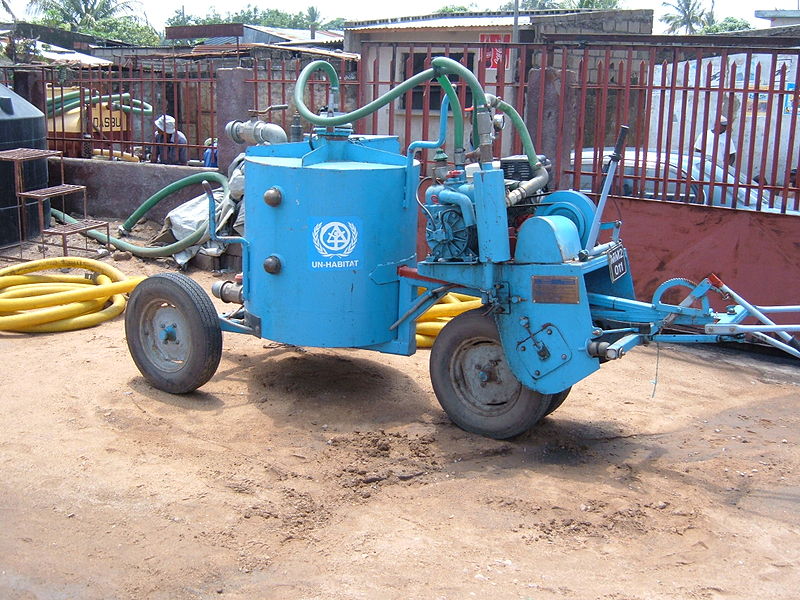
Vacutug for Urban Sanitation


This is a small scale enterprise that UN-Habitat has been developing in Nairobi, Kenya. It is called 'Vacutug' and is a latrine emptying service.

The UN-Habitat site reports that the technology is "being constructed in association with a private-sector engineering company and a Kenyan water NGO. The micro-enterprise earned over US$10,000 over a two-year period and employed four people."

More details of the project can be found in this powerpoint presentation.

There are a number of reasons I like this business: the health and social class benefits of not using manual pit latrine emptying, the health benefits of proper sanitation, the rise in quality of life from proper sanitation, the market size due to the trend of urbanization, the need for the service is high density urban areas or squatter settlements where the walkways are too narrow for a regular sized tanker to reach, and the technology being specifically designed to be affordable and manageable for a microentreprenuer and the possibility for employment. Startup costs look to be around 5,000 per Vacutug.